ASUU Threatens New Strike Over ‘Poor’ Implementation of 2025 Agreement
theoversightnews
ASUU Threatens New Strike Over ‘Poor’ Implementation of 2025 Agreement
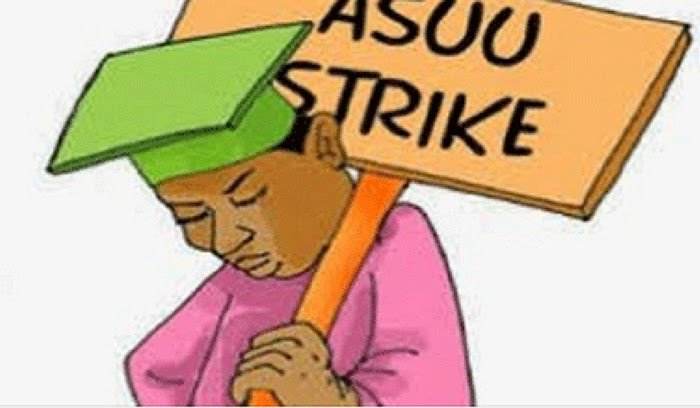
The Academic Staff Union of Universities has warned that Nigerian public universities may witness another round of industrial unrest if governments fail to fully implement the December 2025 agreement signed with the union.
In a statement issued on Monday by ASUU President, Chris Piwuna, the union expressed dissatisfaction with what it described as the “distorted and uncoordinated” implementation of the agreement.
The statement reflected resolutions reached at the union’s National Executive Council meeting held at Modibbo Adama University on May 9 and 10, 2026.
The Federal Government and ASUU had signed a renegotiated agreement in December 2025 aimed at resolving long-standing disputes over lecturers’ welfare, university funding, and institutional autonomy.
The agreement, which took effect from January 1, 2026, included a 40 per cent upward review of the salaries of academic staff in federal tertiary institutions.
However, ASUU said the optimism that followed the signing and public unveiling of the agreement in January 2026 was fading due to the government’s failure to implement key provisions.
According to the union, the Federal Government failed to inaugurate the Implementation Monitoring Committee that was meant to oversee execution of the agreement and prevent bureaucratic bottlenecks.
ASUU alleged that some federal universities were selectively implementing only certain aspects of the agreement, particularly allowances such as the Consolidated Academic Tool Allowance, Earned Academic Allowance, and Professorial Allowance, instead of fully integrating them into the Consolidated Academic Staff Salary Structure.
The union also criticised several state governments for allegedly ignoring the agreement despite their representatives participating during negotiations.
“ASUU will stop at nothing to ensure that all our members fully benefit from the modest gains of the eight-year-long negotiation between 2017 and 2025,” the statement said.
The union warned that frustration among lecturers was building and could trigger another nationwide strike if unresolved issues persist.
“The increasing frustration occasioned by the seeming government’s disinterestedness in the welfare of Nigerian academics is brewing a pent-up anger which could erupt into a new wave of industrial unrest if not addressed,” ASUU stated.
The union also directed that an emergency National Executive Council meeting be convened in the coming weeks to review developments and decide on possible next steps.
The warning comes barely a month after the Minister of Education, Tunji Alausa, assured Nigerians that strikes in tertiary institutions had become a thing of the past.
Alausa had stated that the government had resolved major disputes with ASUU through the 2025 agreement and was close to finalising a deal with the Non-Academic Staff Union.
He also announced that implementation of the 40 per cent salary increase had commenced by the end of January 2026.
“We’ve solved this in totality. So when you get news about looming strikes, treat it as fake,” the minister had said at the time.
Beyond salary issues, ASUU criticised the government’s handling of the proposed National Research Council and expressed concerns over the planned National Research and Innovation Development Fund announced by the Education Minister.
The union argued that the proposal contradicted the provisions of the 2025 agreement, which recommended that at least one per cent of Nigeria’s GDP should be allocated to research, innovation, and development funding.
ASUU questioned why the proposed research fund was denominated in dollars and suggested that the government might be relying on external borrowing or Bretton Woods institutions to finance research activities.
On welfare matters, the union listed several unresolved issues, including unpaid arrears from the 25–35 per cent salary award, promotion arrears, unremitted third-party deductions, salary shortfalls linked to the Integrated Personnel and Payroll Information System, and the withheld salaries related to the 2022 ASUU strike.
The union argued that lecturers continued engaging in research and community service even during strike periods and condemned the withholding of salaries under the “no work, no pay” policy.
ASUU also raised concerns over delays in pension payments to retired lecturers, especially those in state universities, accusing the National Pension Commission of delaying benefit harmonisation.
The union called on President Bola Tinubu to urgently intervene and address outstanding salary, pension, and welfare issues to prevent tensions from escalating.
In addition, ASUU criticised several recent education policy decisions by the Federal Government, including the reversal of the mother-tongue policy for early childhood education.
The union described the move as retrogressive and inconsistent with global best practices, citing countries such as China, Japan, Russia, and South Korea where indigenous languages play major roles in education.
ASUU also rejected plans to establish a campus of Coventry University in Nigeria under the Transnational Education framework, describing the initiative as an attempt to further weaken local tertiary institutions.
The union further opposed the compulsory enrolment of academics into the Nigeria Education Repository Databank, arguing that it violates academic autonomy and may conflict with the Nigeria Data Protection Act 2023.
ASUU also faulted reported plans to scrap certain university courses considered irrelevant by the government, insisting that humanities and social science disciplines remain important for developing critical thinking, creativity, and communication skills.
The union additionally accused some university administrators of poor governance practices, alleging that questionable appointments and titles such as “Professor of Practice” and “Diaspora Professors” were being created for associates and political allies.
It also criticised attempts by the Niger State Government to reclaim the Bosso campus of the Federal University of Technology Minna, warning that such actions could damage cooperation between federal and state governments in future educational projects.
On national issues, ASUU expressed concern over worsening insecurity, poverty, unemployment, and political tension ahead of the 2027 elections.
The union claimed that many welfare programmes introduced by politicians were primarily designed to secure electoral support rather than improve citizens’ living conditions.
ASUU urged governments at all levels to focus on protecting lives and improving the welfare of ordinary Nigerians while addressing the growing hardship across the country.